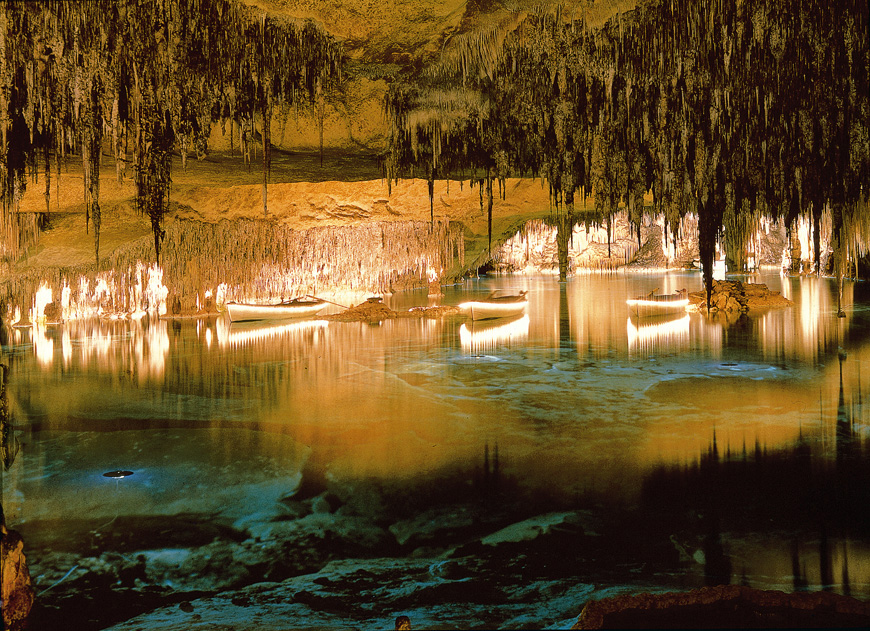
On the eastern coast of Mallorca, near the harbour town of Porto Cristo, lies one of the most visited natural wonders in all of the Balearic Islands. The Cuevas del Drach, or Dragon Caves, are a complex of four interconnected caves that have drawn explorers and tourists since the Middle Ages. What began as local legend about dragons guarding underground treasure has become one of Spain's most celebrated geological attractions.
First systematically explored by the French speleologist Edouard-Alfred Martel in 1896, the caves extend over 1,200 meters in length and reach depths of up to 25 meters below the surface. Martel's expedition revealed what would become the caves' star attraction: a vast subterranean lake that now bears his name.
Lake Martel: An Underground Wonder
Lake Martel (Lago Martel) is the undeniable centerpiece of any visit to the Dragon Caves. Measuring approximately 177 meters long and 40 meters wide, it was once considered the largest underground lake in the world. While that distinction has since been claimed by other discoveries, Lake Martel remains among the most impressive and certainly one of the most accessible to visitors.
The lake's waters are remarkably clear, with a turquoise hue that seems almost impossible given the absence of natural light. The surface acts as a near-perfect mirror, reflecting the intricate stalactite formations that hang from the chamber ceiling. This mirror effect creates a disorienting illusion of infinite depth that has captivated visitors for over a century.
Standing at the edge of Lake Martel, with the cave ceiling reflected perfectly in the still water below, the boundary between stone and its reflection dissolves completely. It is one of those rare experiences where nature surpasses anything a designer could imagine.
The Classical Music Concert
The highlight of every visit to Cuevas del Drach is the classical music concert performed on the lake. As visitors settle into the tiered seating along the lakeshore, the cave is plunged into complete darkness. Then, slowly, illuminated boats carrying musicians emerge from behind the rock formations, drifting silently across the water.
The quartet performs short pieces by composers such as Chopin, Bach, and Albinoni, the music reverberating through the cave chambers in a way that no concert hall can replicate. The natural acoustics of the limestone environment add a warmth and depth to the sound that performers and audience members alike describe as unforgettable.
After the concert, visitors have the option to cross the lake by boat themselves, gliding over the crystal-clear water in what many describe as the most memorable few minutes of their entire Mallorca holiday.
The Four Caves
The Cuevas del Drach actually comprises four distinct but connected caves, each named for the characteristics that early explorers found most striking:
- Black Cave (Cova Negra) - The oldest known chamber, documented since the Middle Ages. Its name comes from the deep darkness that greeted early visitors who explored by torchlight.
- White Cave (Cova Blanca) - Named for the pale limestone formations that dominate its walls and ceiling, giving the chamber an ethereal quality under modern lighting.
- Cave of Luis Salvador (Cova del Frances) - Named after Archduke Ludwig Salvator of Austria, who sponsored early exploration of the system in the 1880s and helped bring it to international attention.
- Cave of the French (Cova dels Francesos) - The section explored by Martel, which contains the famous lake and the most dramatic formations in the entire system.
Geological Formation and History
Like many Mediterranean caves, the Dragon Caves were formed through the dissolution of Upper Miocene limestone by slightly acidic rainwater over millions of years. The process was influenced by fluctuating sea levels during successive ice ages, which alternately flooded and drained the cave system, contributing to the diversity of formations found within.
The caves' proximity to the sea means that Lake Martel is actually connected to the Mediterranean through underground channels. The water level rises and falls slightly with the tides, and the lake's salinity varies depending on seasonal rainfall patterns. This dynamic relationship between the cave system and the sea adds another layer of geological interest for scientists studying coastal karst environments.
Human knowledge of the caves stretches back centuries. Medieval documents reference the entrance to the Black Cave, and local legends warned of dragons that supposedly guarded the caverns. These stories likely arose from the cave's intimidating darkness and the unusual sounds produced by air currents moving through its chambers.
Planning Your Visit
The caves are open daily throughout the year, with multiple tour times available. During the high season (April to October), tours depart approximately every hour from 10:00 to 17:00. In winter, schedules are reduced, so it is worth checking times in advance. Each tour lasts about one hour and follows a fixed route that culminates with the concert on Lake Martel.
Tickets can be purchased online or at the entrance, but advance booking is strongly recommended during summer and holiday periods when queues can be considerable. The caves maintain a comfortable temperature of between 17 and 21 degrees Celsius year-round, so bringing a light jacket is advisable, particularly after the Mallorcan sun.
Porto Cristo itself is a pleasant harbour town worth exploring before or after your cave visit. It has a good selection of waterfront restaurants and a small beach. From Palma de Mallorca, the drive takes about one hour along the Ma-15 motorway, and regular buses also operate the route.
For booking information and current schedules, visit the official Cuevas del Drach website. For broader travel planning in Mallorca, the Spanish tourism board provides comprehensive resources.