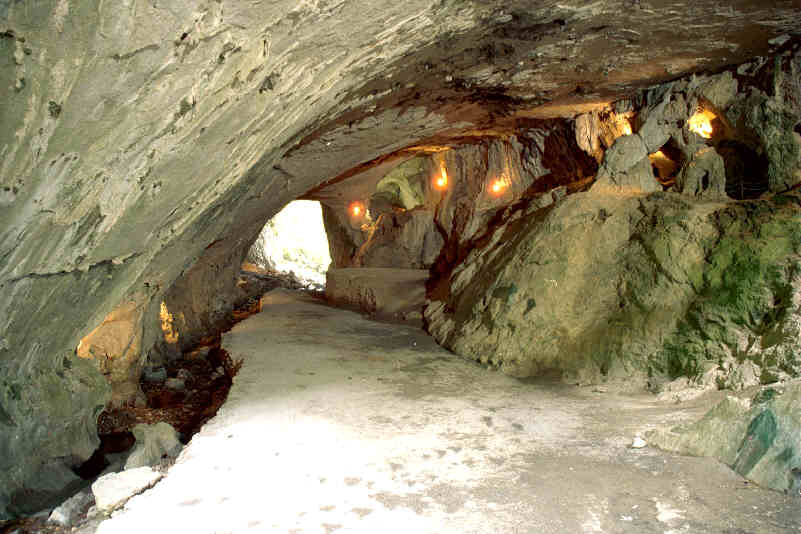
Nestled in the foothills of the Sierra Almijara mountains, just a few kilometers east of the charming coastal town of Nerja in Malaga province, the Caves of Nerja (Cueva de Nerja) rank among the most visited natural attractions in all of Spain. Rediscovered in 1959 by five local teenagers who were out hunting bats, these extensive caverns have since welcomed millions of visitors from around the world.
The cave system extends nearly 5 kilometers underground, though only about one-third is currently open to the public. What makes Nerja truly exceptional is the combination of extraordinary geological formations, evidence of prehistoric human habitation, and a spectacular natural amphitheatre that hosts regular cultural events.
Geological Significance
The Caves of Nerja were formed over approximately five million years through the gradual dissolution of marble and dolomite by slightly acidic groundwater. This slow process created a vast network of chambers and galleries decorated with an astonishing array of stalactites, stalagmites, columns, and flowstone formations.
The most remarkable formation is found in the Cataclysm Hall: a massive column measuring 32 meters high and roughly 13 meters by 7 meters at its widest point. According to the Guinness Book of World Records, this is the largest known stalagmite in the world. Standing beneath it, you get a humbling sense of the timescales involved in shaping these underground landscapes.
The Caves of Nerja are sometimes referred to as the "Natural Cathedral of the Costa del Sol" because of their immense proportions and the awe-inspiring quality of their formations.
Prehistoric Paintings and Archaeology
The Caves of Nerja hold enormous archaeological significance. Excavations have uncovered evidence of human activity dating back to the Upper Paleolithic period, roughly 25,000 to 30,000 years ago. Artifacts including tools, pottery fragments, and animal bones provide valuable insights into how early humans lived along this stretch of the Mediterranean coast.
Perhaps the most debated discovery came in 2012, when researchers suggested that some red seal-like paintings found deep within the cave system might be the work of Neanderthals, potentially dating back approximately 42,000 years. If confirmed, these would be among the oldest known cave paintings in the world, predating even the famous works at Altamira and Lascaux. However, this claim remains a topic of active scientific discussion, and further research is ongoing.
The cave's paintings include depictions of horses, goats, deer, and abstract symbols, many rendered in red and black pigments. While the most fragile sections are not accessible to the general public, the on-site museum provides detailed reproductions and context for understanding these remarkable works.
Visiting the Show Galleries
The public tour route winds through a series of spectacular chambers, each with its own character. The path is well-maintained with electric lighting, metal walkways, and safety railings, making the experience comfortable for most visitors, though some sections involve steep stairs.
- Hall of the Nativity - Named for formations that resemble a nativity scene, this chamber provides an excellent introduction to the cave's diversity.
- Hall of the Phantoms - Dramatic lighting highlights ghostly formation shapes that have inspired legends for decades.
- Hall of the Cataclysm - The most expansive chamber, home to the record-breaking column and featuring evidence of a massive ancient earthquake.
- Hall of the Waterfall - A cascade of flowstone that resembles a frozen waterfall, one of the cave's most photographed features.
The Festival Hall and Cultural Events
One of the unique aspects of the Caves of Nerja is their role as a cultural venue. The large entrance chamber, known as the Festival Hall, serves as a natural amphitheatre with exceptional acoustics. Since 1960, it has hosted the annual International Festival of Music and Dance of the Caves of Nerja, typically held in July.
The festival brings together international artists performing classical music, ballet, and flamenco in this extraordinary setting. The natural acoustics of the cave produce a sound quality that many performers describe as comparable to the finest concert halls. Seating is set up for around 800 spectators, and tickets for these events tend to sell out quickly.
Practical Information for Visitors
The caves are open year-round, though hours vary by season. During peak summer months (July and August), the caves open from 9:00 to 19:30, while winter hours are typically 9:00 to 15:30. It is strongly recommended to purchase tickets online in advance, especially during holiday periods, as daily visitor numbers are limited to protect the cave environment.
The interior temperature remains a constant 19 degrees Celsius with about 80 percent humidity, so a light layer is advisable even on hot summer days. Photography is permitted in most areas, though flash photography and tripods are not allowed. The on-site facilities include a restaurant, gift shop, and botanical gardens that are worth exploring before or after your underground tour.
Getting to the caves is straightforward. From Nerja town centre, it is about a 4-kilometer drive or taxi ride. If you are coming from Malaga, the journey takes approximately 50 minutes along the A-7 or AP-7 motorway. Public buses also run between Nerja and the cave entrance during the tourist season.
For the latest opening hours and ticket prices, you can check the official Caves of Nerja website. Additional travel information for the Andalusia region is available through Spain's official tourism portal.